
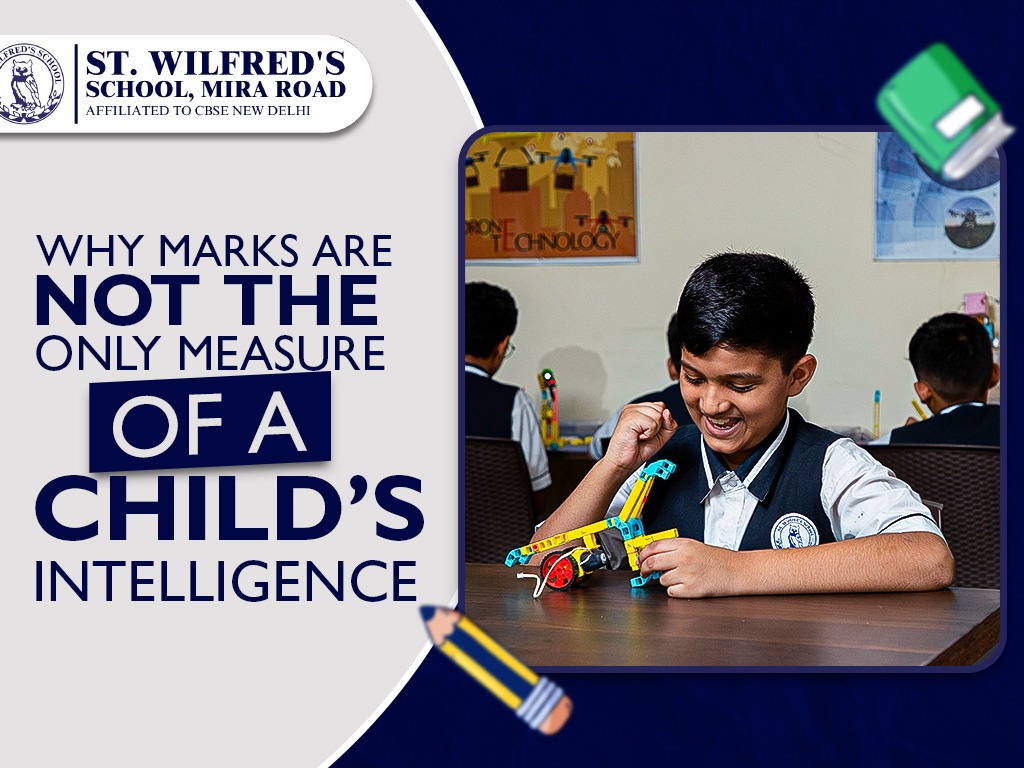
Why Marks Are Not the Only Measure of a Child’s Intelligence
In today’s education system, the present and future of students is decided by their parents solely based on the final percentage on their report card. This is because parents consider it the sole parameter of a child’s intelligence, which is not right. Only considering the marks as the measure of a child’s intelligence is wrong, as they do not capture the complete picture of a student’s intelligence or potential. This is because their abilities, like creativity, leadership, or problem-solving, cannot always be gauged by theoretical exams, all of which are components of the intelligence vs marks in education debate.
Why Marks Are Not the Only Measure of Intelligence
No matter which school your child studies in, even if it is the top school in Mira Road, the marks your child has scored under time pressure and other conditions do not completely define their intelligence. Rather, intelligence is evaluated by considering cognitive, emotional, and social abilities alongside their specific marks in all subjects. The following are some major reasons why marks are not the only measure of intelligence.
- They test memorization of topics more than understanding in many cases
- They do not test creativity and innovation
- They do not assess emotional or social skills
- They are influenced by exam anxiety and external conditions
Intelligence vs Marks in Education
In simple terms, the intelligence of students speaks of their ability to learn, adapt, reason, and solve problems in diverse situations. Meanwhile, marks represent academic achievement within a fixed curriculum that is often a result of rote memorization. The comparison below explains how intelligence is more than exam scores.
| Aspect | Intelligence | Marks |
| Nature | Broad and multi-dimensional | Narrow and exam-focused |
| Measurement | Continuous and contextual | Time-bound and standardized |
| Includes | Creativity, logic, emotions, adaptability | Academic recall and writing skills |
| Long-term relevance | High | Limited if not supported by skills |
Importance of Skills Over Marks
If you have the question of “are marks a true measure of intelligence”, then the answer is no. Rather, one’s intelligence, as seen in their skills or abilities, matters way more than marks in the practical world. The necessary skills to succeed in life are seen in students who actively participate in projects, debates, sports, or creative activities alongside their studies. The following are some skills that define the importance of skills over marks.
- Critical thinking and problem-solving
- Communication and collaboration skills
- Creativity and innovation
- Digital literacy and adaptability
- Emotional intelligence and resilience
What Should Students and Their Parents Focus On?
Parents play a crucial role in shaping how children perceive success and how their future shapes up. Hence, students and their parents should have an equal understanding of what is better for the child. When their focus is only on marks, students may develop stress, fear of failure, or a limited mindset about learning. This is why experts recommend a balanced approach in studies for children to encourage curiosity, exploration, and self-improvement in them. Here are some key focus areas for students and parents:
- Building a growth mindset where mistakes are seen as learning opportunities
- Participation in extracurricular activities like sports, arts, and hobbies
- Actively using efforts towards improvement, not just results
- Maintaining emotional well-being and reducing academic pressure
How to Balance Studies and Skill Development?
After you learn why grades don’t define intelligence and abilities, you need to work on building those abilities that are essential for the rest of your life. According to studies, the various skill development activities students engage in while balancing their studies reduce exam stress and improve performance. The following are some practical ways you can follow to maintain balance between both of them.
- Time management: Allocate dedicated time for studies and activities
- Project-based learning: Combine academics with real-world applications
- Extracurricular activities: Sports, arts, and hobbies
- Self-reflection: Analyze strengths and weaknesses to improve yourself
Why is Holistic Development Important for Students?
Holistic development refers to focusing on the nurturing of all aspects of a child’s growth. These aspects include their intellectual, emotional, social, physical, and creative growth, all of which ensure that a child is prepared not temporarily but for their whole life during their schooling. India’s National Education Policy 2020 strongly supports the holistic development of children all across India. Below are some key benefits of holistic development.
- Better emotional resilience and mental health
- Improved social and interpersonal skills
- Enhanced creativity and innovation
- Stronger decision-making abilities
- Balanced personality development
Conclusion
For students, it is important to learn why writing skills matter in exams to score better. However, it is also important to learn why abilities like creativity, communication, innovation, critical thinking, emotional intelligence, resilience, etc. are important parts of their daily life and work on their development.
Enroll your child at St. Wilfred’s School, Mira Road, for them to benefit from our holistic development approach in teaching and to develop skills and intelligence that make their report cards shine and are also useful in every stage of their life.
FAQs
Q. Are marks the true measure of intelligence?
While marks evaluate the academic efforts, memory, and understanding of a variety of topics and subjects of a student, they are not the true measure of intelligence, which is a much broader part of their personality.
Q. What is more important, marks or skills?
During school time, developing skills is more important than marks, as they prepare a student for better adaptability and competence with the practical world outside school, which fuels their daily life.
Q. What are the 7 different types of intelligence?
According to Howard Gardner’s theory of multiple intelligences, there are seven types of intelligence. These types are: linguistic, logical-mathematical, spatial, bodily-kinesthetic, musical, interpersonal, and intrapersonal.